

Microsoft Using AI and Deep Neural Networks to Improve Translations in Hindi, Bengali and Tamil

Microsoft has announced that it will implement artificial intelligence (AI) and deep neural networks to meliorate real-fourth dimension language translation for three of the most widely-used languages in the subcontinent – Hindi, Bengali and Tamil. The utilize of deep neural networks is expected to provide more accurate and natural translations, which would be a welcome relief for anyone who's tried to translate a foreign linguistic communication to an Indian linguistic communication, only to find weird, unnatural and ofttimes, blatantly incorrect translations.
In a press statement released on the occasion, Sundar Srinivasan, the Full general Manager-AI and Enquiry at Microsoft India, said that "Microsoft celebrates the diversity of languages in Bharat and wants to brand the vast Internet fifty-fifty more attainable. We have supported Indian languages in computing for over two decades, and, more recently, have made meaning strides on vox-based access and car translation across languages".
In case you speak whatsoever of the three aforementioned languages and are interested in trying out Microsoft's AI-powered translations, y'all can head on over to the Bing Translate website to see Microsoft's neural network-driven translations in action. The new tech is also beingness implemented in the company's Microsoft Translator app that's bachelor on both Andriod and iOS. The applied science will also exist used to improve translations on Skype, as well as diverse Office 365 software, like Word, Excel, PowerPoint and Outlook.
I personally tried to translate the kickoff paragraph of this article into Bengali (using Bing Translate), and the results were only as bewildering and incomprehensible as whatsoever translation to an Indian linguistic communication has e'er been. In case you're wondering how it compares to Google Interpret and is familiar with Bengali, have a look at the side-by side comparison below. Notation that it is a composite image with the translation from Google on the right and the translation from Bing on the lesser.
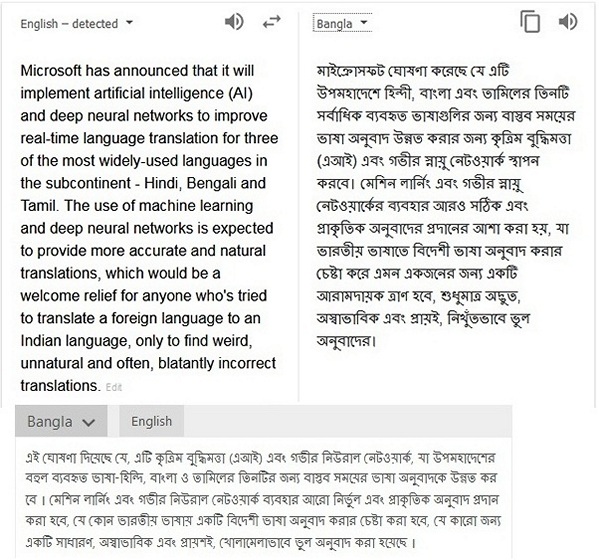
While there doesn't seem to be a lot of difference between the 2 at this stage, the thing to notation here is that with deep neural networks, the translations are likely to better drastically with time, considering the technology has the power to take into account "concepts like gender (feminine, masculine, neutral), politeness level (slang, casual, written, formal), and type of word (verb, noun, adjective)".
Equally things stand now, though, translations to and from Indian languages will continue to remain unsatisfactory, in spite of the fact that tiptop-6 Indian languages are among the top-20 nigh widely-used languages in the world. That'due south because "At that place'due south not enough material on Cyberspace that we could utilize to train the organisation", according to Krishna Doss Mohan, Senior Program Director, Microsoft Republic of india.
Hopefully, with the larger Indian populace starting to use the internet, nosotros'll have more than vernacular content that should assistance railroad train these deep neural networks to provide better translations going forward.

Source: https://beebom.com/microsoft-neural-networks-translations-hindi-bengali-tamil/
Posted by: edwardspacts1965.blogspot.com
0 Response to "Microsoft Using AI and Deep Neural Networks to Improve Translations in Hindi, Bengali and Tamil"
Post a Comment